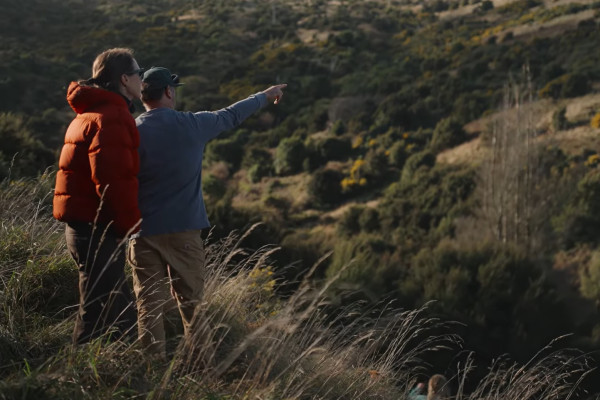
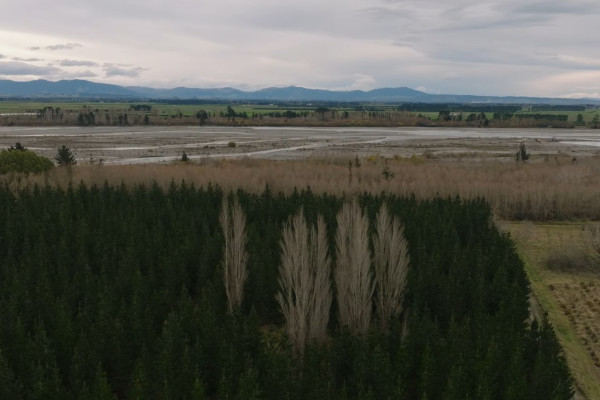
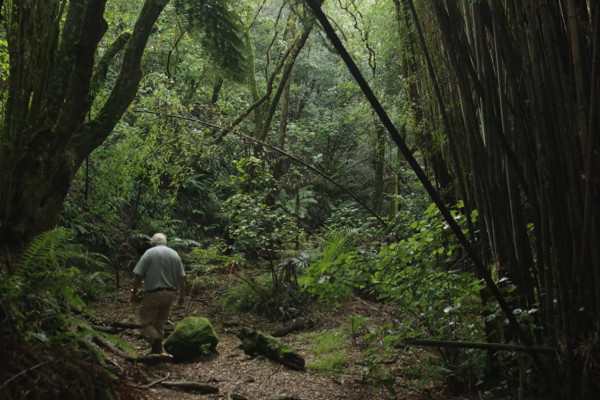
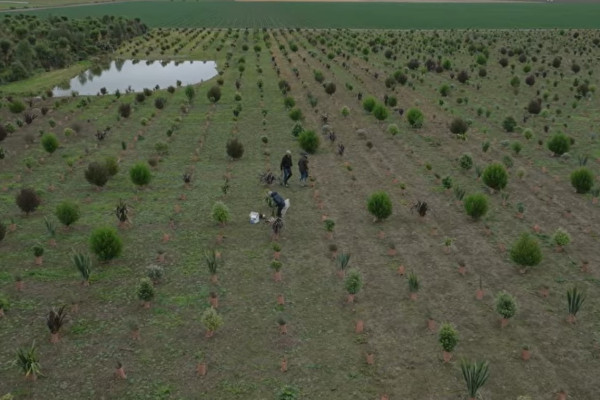
[The title of the video: Restoring coastal landscape to create an eco sanctuary, and logos for the Ministry of Primary Industries and Te Uru Rākau – New Zealand Forest Service appear in front of an image of lots of trees, a wetland and hills in the background.]
[Text on screen: Ōtepoti Dunedin.]
[Alice is sitting in a large shed and talks to the camera.]
[Text on screen: Alice Macklow, Source to Sea Project Manager, The Halo Project.]
Alice: Kia ora. My name is Alice Macklow. I am the Source to Sea project manager for the Halo Project, which is a conservation organisation in Ōtepoti Dunedin.
[Alice is talking and working on site with other people, they’re laughing and putting cardboard plant guards around trees.]
[Footage shows the area of land, it is hilly with patches of grass and is covered in mostly trees.]
Amanda: The Halo Project started in 2009 as a way to protect the species that live inside Orokonui Eco Sanctuary.
[Text on screen: Rhys Millar, Project Lead, The Halo Project.]
[Rhys sits on a bench on a large deck that overlooks native trees and talks to camera.]
Rhys: I'm Rhys Millar. I'm the project lead for the Halo Project.
[An overhead shot of the site shows a body of water surrounded by grassy fields and a mix of trees.]
Rhys: The Halo Project's really made up of two parts, the predator free component and then the ecological restoration component. And those two parts of the project overlap.
[Young trees with plant guards are planted amongst old grass.]
Rhys: So the restoration component is largely about native plant biodiversity enhancement on both public and private lands.
[People prepare plant guards to put around young trees planted at the site.]
Rhys: We've taken quite a strong focus on riparian and wetland areas, but also we are starting to focus on the likes of headlands, particularly where they may provide habitat for some of our coastal bird species.
[A drone shot shows birds flying and sitting on areas of water.]
[Rhys talks to camera.]
Rhys: Some of the really positive things that have come out of this project is the willingness of different community members to come together to help the Halo Project advance.
[Alice is sitting in a large shed and talks to the camera.]
Alice: We're sitting in our nursery shed today, which is a pig shed that is shared to us for free by a local farmer.
[Rhys is sitting on a bench and talks to camera.]
bench on a large deck that overlooks native trees and talks to camera.]
Rhys: A number of tradesmen came together to help set up the irrigation system.
[A group of people stand outside next to lots of plants, a sign says: Freshly Potted.]
[A person wheels a cart with plants in it and then walks among all the plants at the nursery.]
Rhys: A couple of working bees and a few scoops of fish and chips, and now the Halo Project has set up a really well functioning but number eight wire nursery system that is able to lower the cost of plant production.
[A person carries a tray of plants, puts them into a cart and wheels them away.]
Rhys: We often will purchase some small grade eco sourced plants from professional nurseries. We will bring them back to our number eight wire nursery and we'll pot them up, sit on those and let them grow in the nursery. And the outcome of that is we have a stronger, more resilient plant that is able to cope with the conditions here.
[Tree seedlings in pots are blowing in the wind.]
[Alice is sitting in a large shed and talks to the camera.]
Alice: Where we are planting in the Department of Conservation Reserve at Wharewerawera (Long Beach) is part of a larger ephemeral wetland, and we know that healthy wetlands help protect their neighbouring communities from flooding. Flooding is a threat in Wharewerawera, and we want to support the community in that way.
[A shot of the coastline shows the sea and the beach, with trees and a grassy area at the back of the sand.]
[Alice is sitting in a large shed and talks to the camera.]
Alice: So one of the things that everyone in New Zealand has to consider when planting coastally is archaeological remnants.
[A view of the landscape shows hills, trees, grassy fields and the sea.]
[Alice talks to the camera.]
Alice: Māori lived around the coast of New Zealand, so we have to take that into consideration when we plant. We've worked with Heritage New Zealand to create a resource called the Accidental Discovery Protocol, and we use that to train volunteers and our field team and landowners on how they can keep an eye out for archaeological remnants underground.
[Alice talks with volunteers.]
Alice: One of the ways at Long Beach that we mitigate for the risk of harming archaeological remnants is not using an auger. So we use shovels and our volunteers know what to look out for in case they see anything.
[People are walking on a hilly part of the site, behind them are lots of native plantings, some established and some younger.]
[Rhys is sitting on a bench and talks to camera.]
Rhys: We've implemented a number of different approaches for restoration. I guess there's a few key ingredients that we believe in.
[A ute drives along a road surrounded by wetlands. The wetlands are surrounded by young native trees and more established trees in the background.]
[A close up shows plants and grasses blowing in the wind.]
Rhys: One is to work around what already exists. So if you have fragments or you have natural regeneration that might be kicking off, you're immediately starting with a quite a beautiful microclimate. It provides the planted species with protection, which is really important, particularly in these sort of quite windy coastal environments. So we always work around existing native vegetation and build from that. The success is much stronger than working into it in a greenfields environment.
[Plants in the nursery are shown blowing in the wind.]
[Alice is sitting in a large shed and talks to the camera.]
Alice: We discovered that clearing all of the pest plants from the site removed a valuable protection when it comes to wind and exposure.
[Footage shows the dunes at the back of the beach, with cars driving along a track.]
Alice: So this year we are planting into the back dunes and, and we're keeping some of those pest plants around. We'll remove them later just to give the seedlings their best chance of survival from the get go.
[A man is shown clearing an area of land.]
[Alice is sitting in a large shed and talks to the camera.]
Alice: One of the main threats to our seedlings is rabbits and hares, and we use cardboard guards to protect our seedlings from rabbits and hares.
[A volunteer puts cardboard guards around seedlings.]
Alice: We also use the coconut coir mats, which you'll see behind me, to protect the seedlings from weeds and give them their best chance.
[Coconut coir mats are stacked up in the nursery shed.]
[Volunteers are on the deck, talking and looking at the surrounding trees and water in the distance.]
[Rhys is sitting on a bench and talks to camera.]
Rhys: Some of the impact that we'd really love to see would be, for example, full confidence that we can go down to the bay and get a feed of cockles without having any concern that there may be a pollution associated with that.
[Alice looks out at the site and raises her hand to protect her eyes from the sun, she talks with people nearby.]
Rhys: So that ability to resource oneself and the enjoyment that goes with that gathering. We'll see more bird abundance.
[A kererū is sitting in the branches of a tree.]
[Rhys is sitting on a bench and talks to camera.]
Rhys: I get bombed walking down my driveway every morning by kererū, which is fun, and I love it, and I love the fact that those guys bomb me every morning. It would be fantastic if everyone in this area, in the city, up and down the country had that same experience. So we're living in amongst nature in a more normalised way.
[A drone shot shows the variety of different areas on the site, including wetlands, forest, fields and the sea in the background.]
Rhys: We are really lucky here that we have the eco sanctuary. And for people to exist and live within that would be the ultimate outcome.
[A green background appears, text on it says: Visit the Canopy website to learn more about planting trees. Canopy.govt.nz.]
[Logos for the Ministry of Primary Industries and Te Uru Rākau – New Zealand Forest Service appear in front of a green background. Text on the screen says: Te Uru Rākau – New Zealand Forest Service is part of the Ministry for Primary Industries.]